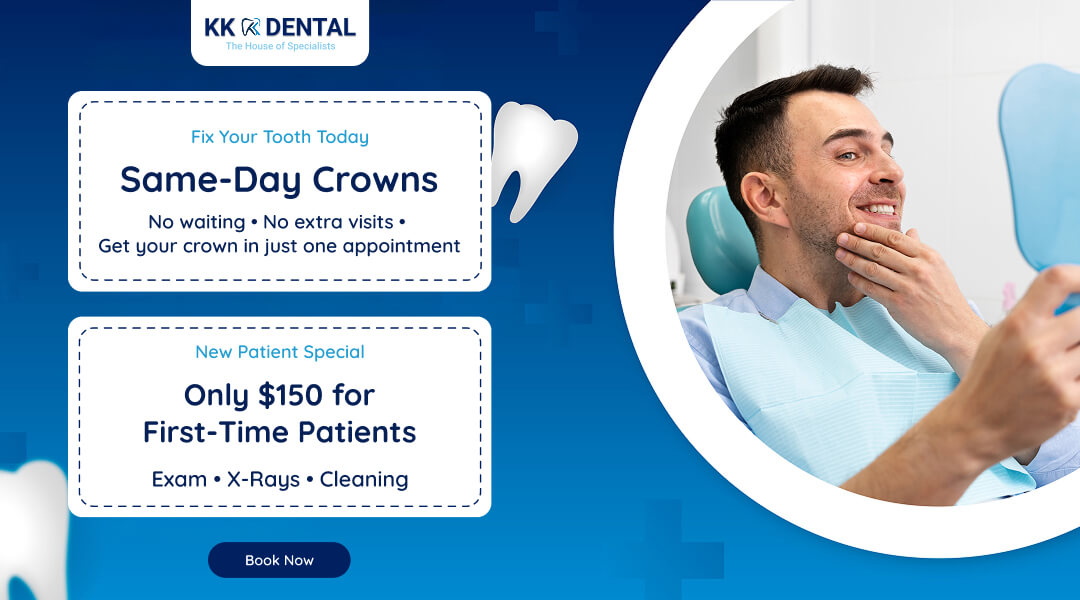


Dental Crowns
You may have heard about a dental crown procedure – sometimes called a dental cap procedure – but unless you’ve been told that you need one, you may not have been paying attention to this amazing restorative dental procedure to know how it can improve the quality of your smile. At KK Dental, we’ve performed countless dental crown procedures for patients just like you in our comfortable dentist office, and we’re happy to provide the following information to help you get more acquainted with how the procedure can help in your restorative dentistry, too!
Most Common Reasons for a Dental Crown Procedure
Although it will require a dental exam to determine the exact reason for your dental crown procedure, following are some of the more common reasons that the treatment is performed by general, family, and cosmetic dentists in:
- To add stability to a tooth that has become compromised due to injury or decay
- To rebuild a tooth that has become worn down
- To cover a tooth that has received a large filling and now requires additional stability
- To serve as an anchor for a dental bridge
- To create a natural-looking tooth surface after a dental implant procedure or other cosmetic modifications
Our Patients Love the Durability of the Dental Crown They Receive from KK Dental
Our patients repeatedly tell us that one of the things they appreciate most about the dental crown procedures we perform here is the durability of the restoration. Our dental crowns can last up to 15 years, depending on the material that is used and proper follow up care such as annual dental exams.
When Gentle Dentistry Matters
Some patients may have a certain amount of anxiety surrounding their dental crown procedure. That’s why the dental care team at KK Dental is committed to practicing general dentistry for every patient we treat. Before any treatment process begins, we will take time to listen to your concerns, answer your questions, and offer solutions to make your treatment as stress-free as possible. This is our promise to you whether you visit our office for a dental crown or any of the other general, restorative, and cosmetic dentistry procedures we provide in our dentist office.
FAQs
A filling may not provide enough support when a tooth has extensive decay, deep cracks, or large areas of missing structure. A dental crown covers the tooth more completely, which can help reduce the chance of further breakage during normal biting and chewing.
Yes, teeth treated with root canal therapy can become more fragile over time because less healthy tooth structure remains. A crown is often placed afterward to improve strength and help protect the tooth from cracking under daily pressure.
A new crown may feel slightly unfamiliar for a short time while your bite adjusts. Most patients become comfortable within several days as the surrounding muscles and teeth adapt to the restoration's shape and contour.
Delaying treatment may allow cracks, decay, or structural weakness to worsen over time. In some situations, untreated damage can increase the risk of tooth fracture, infection, or the need for more extensive dental treatment later.
No, crowns can be used on both front and back teeth, depending on the condition of the tooth. Front crowns are often selected to improve appearance, while back crowns are commonly designed to handle stronger chewing pressure.
The tooth is carefully reshaped to create space for the crown while preserving as much healthy structure as possible. Impressions or digital scans are then taken so the final crown can be designed to fit your bite properly.
Yes, frequent grinding or clenching can place heavy pressure on crowns and natural teeth. Over time, this may contribute to wear, fractures, or loosening of the restoration, especially if nighttime grinding is poorly managed.
Shade, size, shape, and bite alignment are carefully evaluated before the final crown is placed. The goal is to create a restoration that blends naturally with nearby teeth while maintaining comfortable function during chewing and speaking.
Mild sensitivity can happen temporarily after treatment, but persistent pain, pressure sensitivity, or discomfort when biting should be evaluated. These symptoms may indicate a bite imbalance, irritation around the tooth, or other underlying concerns that require adjustment.
A dental evaluation may be helpful if you notice a cracked tooth, pain while chewing, a broken filling, or increased tooth sensitivity. Early assessment can help determine whether a crown is needed before the damage becomes more extensive.